In 2025, Brown & Sterling was honored to be included on the Inc. 5000 list, ranking No. 3373 among the fastest-growing private companies in America. As a small firm, this recognition meant a lot to us. It reflected not only where we had been, but the growth, trust, and momentum we had built over the prior three years.
Brown & Sterling was selected based on 117% three-year growth, a milestone we are incredibly proud of and grateful for. That growth was made possible by our clients, our team, and the entrepreneurs and business owners who trusted us to help guide their tax strategy and long-term planning.
This recognition also marked an exciting step forward for our firm. As Brown & Sterling continues to grow, we remain focused on the same things that got us here: thoughtful guidance, strong client relationships, and high-level tax strategy designed to support business owners as they enter their next chapter.
A heartfelt thank you to our incredible team — you helped make Brown & Sterling one of Washington’s Best Workplaces once again!
We are honored to be recognized by Puget Sound Business Journal as one of the Best Workplaces 2025. This recognition is especially meaningful because it is based directly on employee feedback and workplace satisfaction surveys.
This year, Brown & Sterling was ranked #5 in the category for companies with 10–24 employees. Out of hundreds of organizations across Washington, being recognized among the state’s top workplaces is a reflection of the culture our team creates every day.
At Brown & Sterling, we believe a strong workplace is built on trust, service, collaboration, and caring for one another. We are proud of the environment our employees have helped shape — one where people are encouraged to grow professionally while doing meaningful work that serves our community and clients.
To every member of our team: thank you for your dedication, positivity, and commitment to excellence. This honor belongs to all of you, and we are grateful for the opportunity to work alongside such an outstanding group of people every day.
Several members of the Brown & Sterling team. From Left to Right:
Dave Lawson – Operations Manager; Crystal Quinn, Administrative Asst.; Jennifer Reardon, Managing Partner; Steffen Hefley, Senior CPA, and Jennifer Santiago, Tax Administrator.
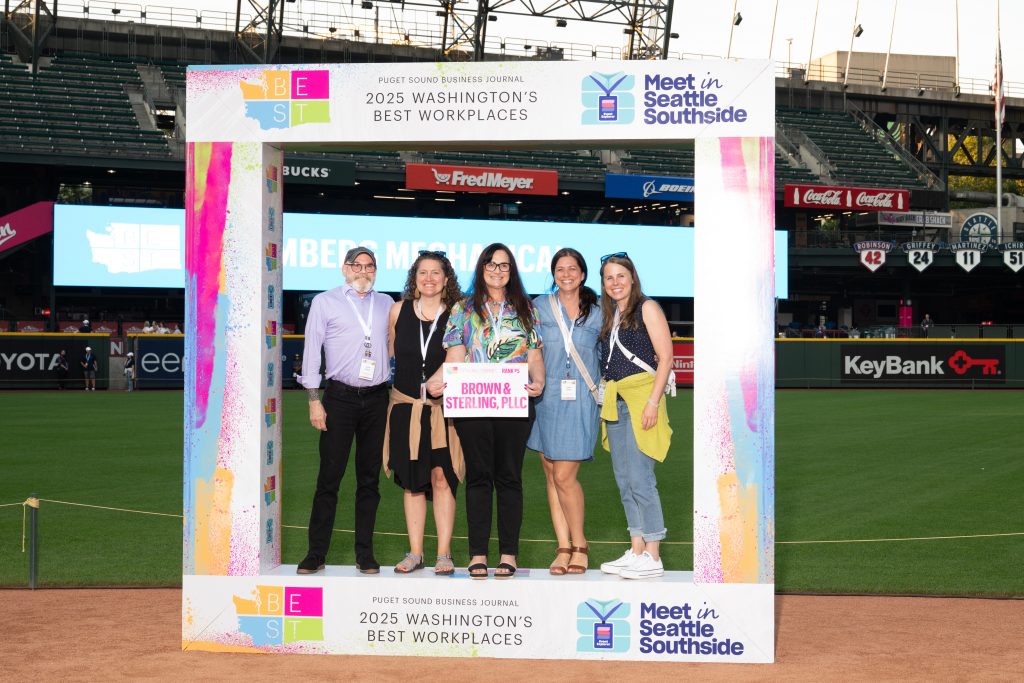
A big thank you to all of our employees – you made us one of Washington’s Best Workplaces!
Brown & Sterling is honored to be named one of Puget Sound Business Journal’s Best Workplaces 2019!

Photo Carol Ladwig/SVR
Brown and Sterling is Number 4 for Small Business on Puget Sound Business Journal’s annual list of the 25 best places to work in Washington – this is a fantastic honor that comes directly from our people! Employee survey responses created the score that put us in the top spot, out of hundreds of applicants, as one of the region’s top employers.

Encompass Board of Trustees
We are pleased to announce that Lawrence Brown has been awarded the 2018 Outstanding Contribution in Human Services Award through The Alliance of Eastside Agencies for his contributions to North Bend based Encompass who provide vital services to areas families. Through Larry’s commitment to providing services and guidance, Brown & Sterling is proud to help promote the success of Encompass and the families they serve.
The following is from the AEA press release:
“AEA is pleased to honor members of the community who have played a significant role in supporting human services in East King County. This event highlights the work of those in the community who make the Eastside a better place for all of us to live and work.”
Read more at the Bellevue Reporter
A big thank you to all of our employees – you made us one of Washington’s Best Workplaces!
Brown & Sterling is honored to be named one of Puget Sound Business Journal’s Best Workplaces 2017!
Photo Carol Ladwig/SVR
Brown and Sterling is Number 17 for Small Business on Puget Sound Business Journal’s annual list of the 80 best places to work in Washington – this is a fantastic honor that comes directly from our people! Employee survey responses created the score that put us in the top spot, out of hundreds of applicants, as one of the region’s top employers.
Be sure to also check out the coverage of this award in the Snoqualmie Valley Record.
We’ve been thinking lately of a favorite scene from 1978’s Heaven Can Wait , a Warren Beatty remake of a 1943 film, Here Comes Mr. Jordan. The film’s premise is this: a quarterback, Joe Pendleton (Warren Beatty,) for the L.A. Rams dies, but it’s not his time. It’s a mistake. Mr. Jordan (James Mason), a nebulous Heaven official, swaps Joe into the body of a multi-multi-millionaire. All Joe wants to do is play football. He decides to buy the Rams. The next scene is the shot below, it’s the owner of the Rams with his attorney.
Lawyer: What’s wrong?
Owner: He got my team. The son of a bitch got my team.
Lawyer: What kind of pressure did he use, Milt?
Owner: Well, I asked for sixty-seven million –
Lawyer: And?
Owner: And he said “okay.”
Lawyer: Ruthless bastard.
Just a great movie moment, especially for attorneys who advise businesses. It’s funny and it makes a point. You don’t always know when you’re going to get an offer for your company. You can have a lot of plans for a lot of contingencies (especially if you work with us) but you may not have a plan for when a ‘ruthless bastard’ walks through your doors and makes what may seem like an outrageous offer.
The very act of receiving the offer sets off a series of ever widening issues. There are considerations of considerations. Employees, contracts, assets, agreements, retirement plans, it goes on and on and on.
Then, there’s valuation. A great offer is stunning, exciting, fulfilling … and cause for some wonder. As in “Why so much?”
So, what about selling the Rams for $67 million in 1978? With inflation, that $67 million was the equivalent of $251.5 million today. Not bad. The Rams moved to St.Louis, were bad, got good, won a Superbowl, got bad again, got really bad, moved back to Los Angeles. Where they are simply awful. And, according to Forbes, currently valued at $2.9 billion. That’s billion with a ‘B’.
Not being ready to handle a sudden offer didn’t work out so well for the Rams’ movie owner.
HBO’s Silicon Valley is funny – sometimes hysterically so, smart – sometimes ingeniously so, profane, and, ultimately, really, really entertaining. It is also, sometimes spectacularly so, a primer on business planning.
 For those who may not be following Silicon Valley (if you own a startup, it is a must see, start from episode 1 of season 1 … now), it’s a half-hour comedy centered around a tech startup operating out of a Silicon Valley ‘incubator’ that looks a lot like a ranch house in the suburbs. Because it is.
The company is called Pied Piper (to everyone but the founder’s derision), it has developed an algorithm that could revolutionize file compression – making video, chats, and a whole lot of other internet stuff a lot faster.
The product has great potential. The company needs money. Through the first seasons the show takes a meandering, crooked, ultimately accurate path as Pied Piper deals with venture capitalists, non-disclosure agreements, trademarks, intellectual property, employment contracts, non-compete clauses, investment agreements, proxy fights, board of director formation/dissolution/reforming, succession issues, conflicting duties among officers, offer sheets, lawsuits … the show has them all, and a lot more.
Silicon Valley gets almost everything right. It’s been written about and talked ever since it first aired in 2014. It has been universally hailed as a dead-on look at start-ups and business in the 2010s.
When we started this post about a week ago, when HBO launched the new season of Silicon Valley, we had every intention of centering this post around a few of the many great real-life business scenarios the show has covered so far. Then, of course, tie it into what we see every day.
There was a lot there, and we’re reasonably sure it would have made a good post, but then a funny thing happened. We ran across an article from The New Yorker. It was about how Silicon Valley is written and filmed. The detail and planning involved in every episode – and each season – are simply mind-boggling.
The show has two hundred advisers and consultants, most of them volunteers. They include “academics, investors, entrepreneurs, and employees at Google, Amazon, Netflix, and other tech firms.” Everything that ends up on the TV screen has been vetted a dozen times.
How in-depth do they get? “If someone is holding a document on the show, that document is written out, in full, the way it would be in real life.” Post-it notes, lines of code, whiteboards, all have real formulas on them. The producers are convinced that the more work they do to make things real, the more “the process leads” them to better ideas, better shows.
In-depth planning, active, welcome involvement of outsider advisers and consultants, HBO’s Silicon Valley is doing what every company should be doing in the real world. Every company, that is, except for Pied Piper, if they ever used someone like us, the show would way too boring for TV.
 You probably saw the Anheuser-Busch ad during the Super Bowl. You know the one, it went somewhat viral after the game because a lot of people saw it as some kind of comment on immigration.
Regardless of one’s political leanings, it was an effective ad – two immigrants meeting in St. Louis around the time of the Civil War and launching Budweiser. Coors, of course, has a parallel story, almost at exactly the same time Anheuser and Busch met, Adolph Coors was getting his brewery up and running just a little way to the west.
The rest, as they say, is history, by the 1980’s Anheuser-Busch and Coors were the first and fourth largest breweries in the United States. In third place was Stroh’s. Stroh’s . . . you can be forgiven for never having heard of them, never mind ever sipping one.
Yet, in the early 1980’s Stroh’s was a household – well, at least a beer-drinker-in-the-mid-west household – name. Even if you never had a Stroh’s you had heard of them. Like Coors and Budweiser, Stroh’s was founded by an immigrant in the mid-1850s. Like the Coors, Anheusers, and Buschs, Stroh’s started as a family business. Like the Coors, Anheusers, and Buschs, the Stroh’s passed the business down for four generations.
Unlike the Coors, Anheusers, and Buschs, the Stroh’s didn’t survive and thrive into the 1990s. Neither did the Stroh’s family fortune, at one time one of the largest family fortunes in the United States.
It’s not often that real life allows a direct comparison of companies over a century like a business school problem, but that’s the Coors, Anheuser-Busch, Stroh’s scenario. Family businesses that made it – while surviving Prohibition, no less – from the Civil War through to the Reagan years.
Then, in the space of ten years or so, there were two.
As you can probably guess, there is no one reason for Stroh’s demise, there are many. But they all revolve around one theme, bad planning.
Not bad decisions, bad decisions can be rectified, overcome within a good plan. It seems that Stroh’s never really had a plan for the future until the future was on top of them. Which, of course, is too late.
Stroh’s made beer in Detroit. They marketed mostly to the Mid-West. They, obviously, had a great, loyal  following. They had decided generations earlier that only the men of the family would run it, no women, no outsiders. They had decided generations earlier that every family member would get dividends for life … regardless. An easy thing to support through a generation or so, but by 1980 Stroh’s dividends were paying for the lavish lifestyles of some twenty-seven family members, only a few of whom were working in the business.
It’s easy to imagine the business being run like a large, benevolent fiefdom. Stroh’s had an entrenched market, but made the mistake of becoming entrenched as a company. After one hundred and twenty years of success doing it the ‘family way’ no one running the company apparently saw change coming, certainly never thought to plan ahead.
So, when change did come, it – as change has a way of doing – came fast and Stroh’s wasn’t ready. What happened to start it off is what happens to all successful companies across the spectrum of industries, a competitor began to push. In Stroh’s case it was their fellow-immigrant founded in the mid-1800’s company, Coors.
Coors was spreading eastward. By the late ’80s their sales were poised to surpass Stroh’s. Stroh’s management wasn’t ready. They seem to have panicked. In a short period of time they tried a series of increasingly ill-advised, knee-jerk-like reactions. None worked, just piled debt into the equation. By the time Stroh’s had to fire-sale their assets, including the Stroh’s brand, they had even tried to diversify into bio-tech.
It all gets us thinking – the only companies that need planning more than start-ups are established, successful ones.
Back when it seemed that no one would ever beat him, back when he was on the cover of countless magazines, Mike Tyson was asked about an upcoming fight and his opponent’s plans to beat the unbeatable fighter. Tyson replied, “Everyone has a plan until they get punched in the mouth.”
Great line, it made headlines, he won again. Tyson was actually quoting the great Joe Louis, Louis said “Everyone has a plan until they get hit.” That quote had lain dormant for decades until Tyson resurrected it.
 In either version, nowadays the quote is extensively employed. It seems as if its used mainly to illustrate (if not champion) the idea that audacity and force either stuns or disables planning. It’s a kind of bravado.
I was reminded of this quote – in a very roundabout way – by a passage in Ronald White’s new biography of Ulysses S. Grant. It’s about Grant’s first experience with the Army of the Potomac after he was installed as the Commander-in-Chief of all the Union Armies in 1864.
Grant chose to go into the field with the Army of the Potomac rather than sit in Washington and ‘manage’ the war from there. In joining the Army of the Potomac he was joining an army that was, at best, dysfunctional. An army that had been soundly beaten in almost every battle it had ever fought against Robert E. Lee and the Army of Northern Virginia except Gettysburg. And, that was close. Very close.
The Army of the Potomac, then, wasn’t Grant’s army, he was, in essence, the new Chairman of the Board,  management stayed the same. He did, however, order the offensive in May, 1864 that resulted in the Battle of the Wilderness.
The Army of the Potomac attacked on May 5th and suffered a severe setback. All the while, Grant, stoic, sat and observed George Meade and his generals as they conducted the battle. He received updates but otherwise kept to himself and watched, listened.
That night, when it was crystal clear that the day had been horrific for the Union forces, several officers took it upon themselves to tell Grant about the horrible things Robert E. Lee was probably out there in the dark getting ready to do the the Northerners. Dire warnings of flank attacks and utter destruction.
Grant was famous for being implacable. That implacability snapped after about ten minutes of ‘Lee-will-do-this-to-us’ warnings.
He exploded, “I’m damned tired of hearing what Lee is going to do to us … it is about time we start talking about what we are going to do to him.” The battle resumed the next morning, the North fought to a draw, moved south the next day and began the offensive that eventually ended the war.
Then, there was the Superbowl Sunday night. You may have heard that the New England Patriots were down 28-3 in the third quarter then scored thirty-one straight points to win it in overtime. It was the greatest comeback (by far) in Super Bowl history and fifth greatest in the history of the NFL – for any game.
There’s been a lot of writing about how and why this happened. As the 3rd quarter ended the Patriots had a .04%  chance of winning. Yet they did. The best explanation I’ve read on why this happened was in FiveThirtyEight. They simply stated that in the second half the ‘Patriots went back to being the Patriots and the Falcons went back to being the Falcons.’ What they meant was that the Patriots played the first half as a shadow of their usual selves while the Falcons played out of their minds good – virtually perfect.
They went on to cite the fact that despite getting blown out the Patriots approached the second half like they always approached a second half. They made some changes to counteract what the Falcons were doing, then they executed their game plan as if the score was 0-0. The rest is history.
So, here’s what hit me with all this – the important thing, the really important thing in life and business and sports and everything else – is to have a plan for what to do after you get punched in the mouth.
That’s the thing. Grant was a great planner. Bill Belichick is . . . well, Bill Belichick. With them, it’s all about contingencies for contingencies. Their planning included contingencies for getting hit. Hard.
Good planning, then, plans for getting smashed in the mouth. And for what to do while it still hurts.
We posted a quick piece about the World Chess Championship now being played in New York City. The website FiveThiryEight has a running commentary on the matches, we shared one of them with a note about chess and planning … you know the deal, it’s a metaphor made fairly often.
But, upon some deeper reflection, it’s not really a perfect metaphor. It’s easy one to use (too easy?) – you know, ‘business planning is like chess, every time you move the board changes and you have to re-plan and re-think, move again and then go through it all over again until at last …. That part, ‘at last’ is the problem, I think. Because, no matter how you look at it, people play chess to win.
This simple yet vitally important fact is too often overlooked.
 Chess is a great intellectual exercise but the minute two people are sitting across from one another make no mistake, it’s about winning. The two men playing by the South Street Seaport in Manhattan, Magnus Carlsen of Norway, the defending world champion and Sergey Karjakin of Russia, currently the seventh ranked player in the world, are certainly only thinking of winning.
Any thoughts you might have that chess isn’t every bit as competitive as football or hockey or … anything, will be instantly dispelled watching last year’s Pawn Sacrifice, the story of the Bobby Fisher – Boris Spassky chess championship in the early ’70s. Toby McGuire did an amazing job portraying Fisher and his mental deterioration. The movie takes the position, clearly, that the stresses of high-level chess played a big part in that deterioration. Winning is everything.
I’m struck by this – it’s from the film but it’s also directly from Fisher’s life: In an interview with a magazine, Fischer’s coach explains to an uninitiated reporter, “after the first four moves of any chess game there are 300 billion possible move combinations.”
Sure, that’s a staggering amount of combinations and, on a lesser scale, it does conjure images of working through a a business plan. Or sale. Or purchase. It’s Fischer’s response to his coach’s assertion that blows the metaphor apart: “People think there are all these options, but there is only one right move.”
“Only one right move.” It’s true for chess. A million, million possible combinations after every move, but only one right one if you want to win. Need to win.
That’s not remotely true with business planning – in any of it’s variations. There are many right moves, it’s just that the order of them can sometimes be vital. It’s never about winning – even business sales and purchases- it’s about doing it right and continuing to be successful. Chess players have to win to be successful, business owners just have to plan, be smart, and think ahead – like a great chess player.